



Weeping Willow
Whose gaze doesn’t stop on the stoic, graceful Weeping Willow seen from their car window when driving by? The statuesque weeping willow can dominate a landscape and is recognized at a glance. Whether situated alone in a yard or adorning a lake or pond with its spiraling branches arching to the ground, adorned with its long, narrow bright green leaves. Adaptable to many soil types and both acidic and alkaline soils, it does prefer medium to wet conditions. It flowers in late winter or early spring on attractive yellow/green catkins.
| Trade Name(s) | Weeping Willow, Babylon Willow |
|---|---|
| Botanical Name | Salix babylonica |
| Foliage Type | Deciduous |
| Growth Rate | Fast (more than 24 inches/year) |
| Mature Height | 30-40 feet |
| Mature Width | up to 40 feet |
| Sun Exposure | Full Sun to Partial Shade |
| Root System Depth | Fibrous, Shallow |
| Soil pH | Acidic, Alkaline |
| Soil Type | Clay Soils, Loamy, Moist, Well-drained |
| Fall Leaf Color | Golden Yellow |

Related products

Dawn Redwood
Thought to be extinct for 20 million years, the Dawn Redwood lives! Fossil records show the Dawn Redwood prevalent in North America and the entire northern Hemisphere up to 66 million years ago, but it was thought to be extinct. In the 1940’s, a Chinese botanist found stands of the tree in a low lying valley in China. The dawn redwood is a cousin to the Bald Cypress and the mighty Sequoya and is a magnificent center piece planting. Growing up to just over 100 feet it is the smallest of the conifer family referred to as “Redwoods”. The Dawn Redwood is a deciduous conifer that grows in a pyramidal shape and is one the fastest growing trees in North America. It sports delicate leaves that look similar to ferns and are super soft to the touch. While young its trunks can appear smooth and red when wet, and when mature has bark with attractive deep clefts. It prefers moist, well- drained soil and direct sunlight, but can tolerate clay soils, dry time, pollution and road salts well. It should not be planted where standing water accumulates often. It is perfectly suited for Midwest planting.


Eastern Redbud
The Eastern Red Bud is unmistakable in Spring with its spectacular pink and rose colored blossoms. Its branches branch outward low on the trunk and ensures no two redbuds look alike. Adaptable to varied soil types and PH, moderate growth rate and stunning Spring blossoms make the Eastern Red Bud a favorite accent piece to landscaped flower gardens. It prefers moist, well-drained soil and should not be planted in areas with standing water.


Emerald Green Arborvitae
This popular conifer is easy-to-care for and as an evergreen provides visual interest even in the winter months. Emerald Green arborvitae can be used for live screens and hedges. It has flat glossy green needles and may produce tiny, ruddy- brown pinecones. The tree initially grows fast in its early years and then slows down as the trees mature.


Ginkgo Tree
The Ginkgo Biloba is a beautiful, slow growing deciduous tree that has “leathery” green leaves in summer, turning brilliant yellow in the fall. Its fan shaped leaves are quite unique and closely resemble that of the maidenhair fern plant. The Ginkgo is frequently referred to as “the maidenhair tree”. This ancient tree is highly resistant to insects, deer and pollution. It thrives in urban plantings, likes sandy well drained soil but adapts to clay soils as well. The Ginkgo growth pattern is unique in that it grows straight up without branching outward for between 8-10 years and then begins fanning out its canopy. Not a fast-growing tree but one certainly worth the wait!
Initially thought to be extinct, Ginkgo Biloba is the only surviving specie of the family Ginkgoaceae. Considered Endangered in the wild, the Ginkgo is a living fossil dating back to the Middle Jurassic Period @ 180 million years. A few small tracts of “wild” Ginkgo’s exist today, and only in Southern Asia.

Hackberry
The Common Hackberry can grow in just about any soil, PH and moisture range. A medium to fast growing deciduous shade tree, the Hackberry grows in a pyramidal shape when young, the eventually fills out with a broad, arching canopy when mature. It has bright green leaves with serrated points on the top third and turns to a lovely yellow in fall. Mature Hackberry’s trunk-bark develops into a series of “ridges and valley’s” of irregular shape which is its unmistakable characteristic. Its fruit are small oblong “drupes” which start out red in summer, ripen and turn purple in early-mid autumn. They remain on the tree throughout winter and provide non-migrating birds a valuable food source for the winter
October Glory Maple
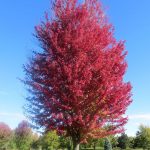
The October Glory Maple is a cultivar of the Red Maple. It is fast growing, keeps its deep green leaf color throughout the summer, and wow’s us in autumn. When one thinks of striking brilliant Orange foliage they’ve seen in autumn, the October Glory Maple is what they recall. In some years a dull burnt orange or red, in other years an almost iridescent neon orange! Birds and small mammals are attracted to their “helicopter” seeds that have fallen, and pollinators are attracted to the tiny red flower blooms that appear in spring. The October Glory can adapt in many different soil types, but prefers moist, acidic soils. Once established, its fall foliage colors are very reliable, turn colors a bit later than other Maple’s, and also keep their fall colors longer than most others.


Royal Purple Smoke
Is it a tree, or a bush? The Royal Purple Smoke is actually a deciduous shrub that is a stunning accent tree / shrub in any landscape. Eventually growing 10-15 feet tall and wide, it sports gorgeous maroon-red / purple leaves that are certain to catch the eye. But that’s not all! The “Smoke” comes from billowy “hair like” puff balls that appear from the tree’s stalks where it’s tiny yellow flowers bloomed. Though the flowers are deemed insignificant, the “smoke balls” are highly attractive. The Purple Smoke can be vigorously cut back in the VERY early spring and this will promote vigorous and larger leaf growth, but at the expense of the blooms. It is a plant where “less is more”. It does well in highly drained “rocky or loose soil”, and does not like wet feet or soils that remain saturated. Once established, it requires only moderate water and is drought tolerant, requires little fertilizer or maintenance (save for how you wish to prune it).
Is it a tree or a shrub: you decide!
Silver Maple
The Silver Maple is a fast growing shade tree that sports the signature Maple Leaf in summer with green topside, and silvery on the bottom. For many years this tree was the go to tree for growing urban street plantings because of its rapid growth, but its shallow root system made that counterproductive. It is the fastest growing maple and thrives in wet river bottom and lowlands, but tolerates drier soils as well. It is an excellent choice as a Rain Garden tree or planted in wetter than normal areas. As with all Maples, they require pruning to keep their shape and will provide shade faster than any of their Maple cousins. This is a Maple for shade and beauty in the summer, not for brilliant fall foliage. It transplants well and is a favorite for robin nesting and its signature “helicopter” seeds (samaras) are devoured by squirrels, birds and other small mammals.
 Evergreens
 Ornamental Trees
 Flowering Trees